
Plastics & Injection Molding · ERP guide
ERP for plastics and injection molding plants: what the system has to manage
A moulding plant's output depends on the mould, the machine, the cycle time and the cavities, and every part should trace back to its resin lot. This is what an ERP has to manage in that kind of plant, and where an accounting-led ERP leaves gaps.
By Nexfloe · · 10 min read
- Industry:
- Plastics & Injection Molding
- Article type:
- ERP guide
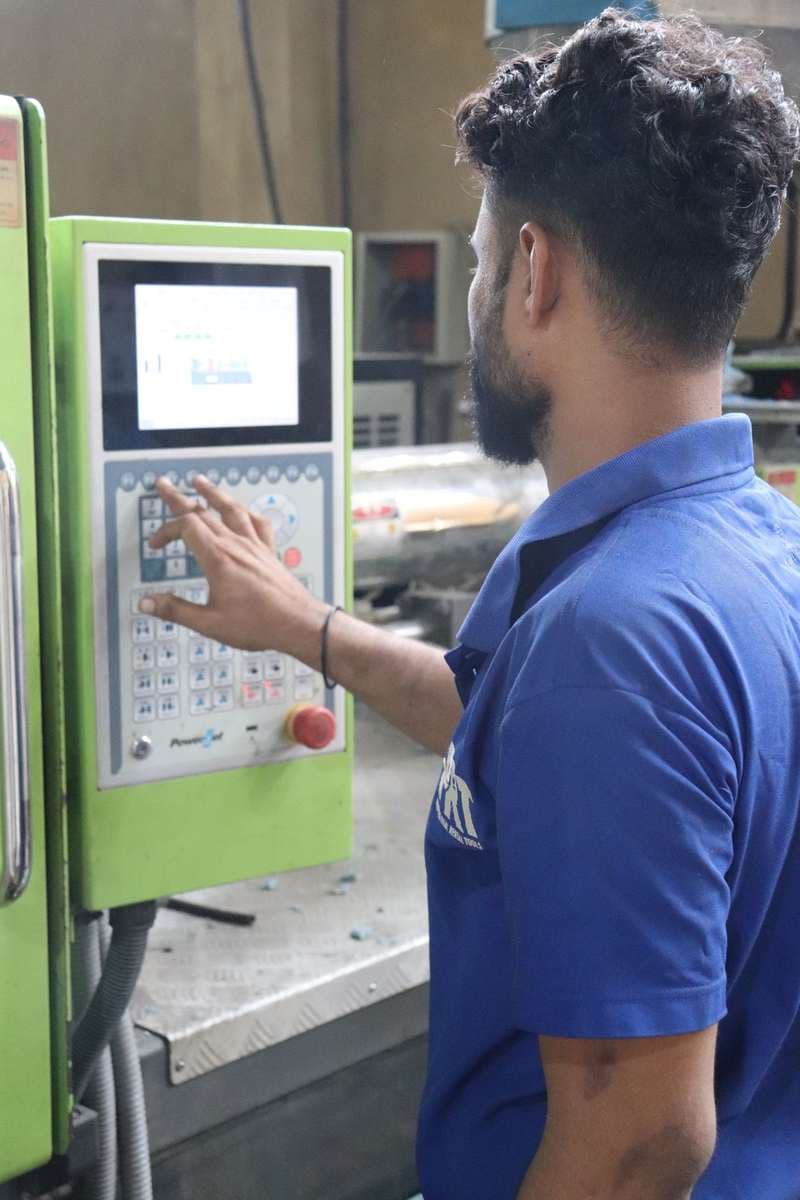
A moulding shop looks simple from the office. A mould goes on a machine, resin goes in the hopper, parts come out. On the floor it is less tidy. The machine runs three shifts, the cycle time creeps up by a few seconds overnight, a cavity gets blocked off after a short shot, the mould change at 2 am takes twice as long as planned, and the masterbatch lot changed halfway through the job. None of that shows in a sales order and an invoice.
This guide covers what an ERP has to manage in an injection moulding or plastics plant, how work flows through it, and what to check before choosing one. It is written for plant heads, production planners and quality managers at custom moulders and plants making their own products.
Quick answer
An ERP for a plastics or injection moulding plant plans jobs on machines with the mould assigned and mould changes as planned time. It sets a target rate from cycle time and cavities, issues resin, masterbatch and regrind by lot, records counts, downtime and scrap by cause per machine and shift, holds batches that fail inspection, follows secondary operations at vendors, and links each finished lot to its resin lots.
Why moulding plants need a manufacturing ERP
Most ERP systems start from the ledger: purchase, stock, sale, invoice. That covers buying resin and billing parts. It does not cover what decides the margin in a moulding plant, which is how many good parts each machine made per hour against what the mould should give, how much time went on mould changes and stops, and how much material ended up as runners, startup scrap and rejects.
Those numbers live on the floor. If they are written in a shift register and typed into a sheet the next day, the office sees a total, not the machine that ran slow or the mould that flashed for half a shift. That is why moulding plants usually need ERP and MES (manufacturing execution) on one record: the plan, the material and the cost on one side, and what each machine actually did, shift by shift, on the other.
Common challenges in plastics and injection moulding
- Slow machines go unnoticed. Without counts against cycle time and cavities, a machine running at 28 seconds instead of 24 looks the same as one on target until the order is late.
- Mould changes are not on the plan. The change is treated as a gap between jobs, so when it overruns, every job after it slips and nobody can say why.
- Resin and masterbatch cannot be traced. A customer reports a colour shade or a brittle batch, and finding the resin and masterbatch lots behind those parts means going through bag tags and stores slips.
- Regrind is outside the books. Runners and rejects are ground and fed back, but nobody records which lot went where or how much, so consumption never matches.
- Scrap is a total. The plant knows it rejected a few thousand parts this week, but not how many were short shots, flash or sink, on which mould, or in which shift.
- Downtime has no reason. Heater faults, mould water problems, waiting for material and waiting for the setter all end up as one blank in the register.
- Secondary operations go out of sight. Pad printing, ultrasonic welding, insert assembly or plating at a vendor go out on a challan and come back with a count nobody checks against it.
- Cost per part is an estimate. Part weight, runner loss, scrap, machine hours and vendor charges are not added up on the order, so the price is defended with the quotation sheet.
What should a plastics ERP system include?
The list below follows how a moulding plant actually runs. Each part of it should sit on one record, not across a planning sheet, a stores register and a QC file.
BOM: resin, masterbatch, inserts and packing
The BOM for a moulded part is short but specific: the resin grade by weight per part, the masterbatch at its let-down ratio, any regrind allowed, metal inserts, and the packing material. If the part goes on to assembly, the BOM is multi-level. The revision used for an order should be fixed when the order is released, so a change of grade next month does not alter the record of parts already made.
Production planning on machines, with the mould as part of the job
A job needs both a mould and a machine the mould fits. The plan places jobs on machines by the hour against each machine's capacity, and the mould change is an operation with its own time, so it takes capacity like a job does. An overloaded machine should show before the job is released, not when the operator is waiting. Production planning in FleekERP places orders on work centres in this way.
Target rate from cycle time and cavities
The expected output of a job is the shots per hour from the cycle time, multiplied by the working cavities. That target should sit on the job, so logged counts can be compared against it during the shift. If a cavity is blocked off, the target changes, and the record should show it.
Material traceability: resin, masterbatch and regrind by lot
Resin and masterbatch are received against the supplier's lot, checked on receipt, and issued to the job by lot. Regrind is its own item with its own lot, issued to a job like any other material, so it shows in consumption instead of disappearing. Each finished lot should then trace back to the material lots inside it. See how inventory and lot traceability records this.
Inventory: raw material, WIP and finished goods
Stock has to be known by lot at three points: resin, masterbatch and inserts in stores; moulded parts waiting for a secondary operation, in-house or at a vendor; and finished goods packed and waiting for dispatch. Material should be allocated to released jobs, so two jobs cannot count on the same bags, and consumption should follow the counts rather than a month-end adjustment. When month-end resin stock never matches, consumption is usually being estimated, and regrind is usually part of the gap.
Shop-floor execution per machine and shift
Operators record the counter reading, scrap with a cause, and downtime with a reason against the machine and the job, and supervisors see output against the target rate during the shift. Without this, the ERP knows what was planned and not what each machine did. In FleekERP these entries are made on shop floor apps at the machine. The counts are logged by the operator; they are not read from the machine.
Quality: first-off, in-process checks and batch hold
After every mould change or restart, the first shots are checked and approved before the run counts as production. During the run, QC checks weight, dimensions and visual defects at a set frequency. A failed check holds the batch until quality decides between rework, use as is, or reject. Scrap should be recorded by cause: short shot, flash, sink mark, silver streaks, burn marks, colour variation. Quality control in FleekERP records checks at the operation this way.
Secondary operations and job work
Printing, ultrasonic welding, insert fitting, assembly and plating may be done in-house or by a vendor. A vendor step should sit on the routing in sequence, with the challan out, the return counted in, and any short return flagged on the order.
Dispatch by lot
Finished goods are picked by lot against the customer order, so the delivery note carries the trace forward. When a complaint arrives with a delivery date, the plant should get from the delivery to the moulding batch, the machine, the shift and the resin and masterbatch lots in one search.
Cost per part and per order
Resin and masterbatch at the cost of the lots issued, regrind, scrap, machine time, mould change time and vendor charges, added up on the order. Without this, the plant learns which parts lose money only when the year closes.
How work flows through a moulding plant
A custom moulder and a plant making its own containers or housings differ in detail, but the sequence is much the same. The step-by-step guide to the injection moulding process from order to dispatch goes through each stage in more depth.
- 1Customer orderPart, quantity and delivery date, with the mould and the machines it fits.
- 2BOMResin grade, masterbatch, inserts and packing, with the revision fixed on the job.
- 3Material planningResin and masterbatch needs are checked against stock by lot and open purchase orders.
- 4Production orderThe job is placed on a machine with the mould change before it, and material is issued by lot.
- 5MouldingFirst-off approval, then counts, scrap by cause and downtime with a reason, per machine and shift.
- 6Secondary operationsPrinting, welding or assembly in-house, or at a vendor against a challan.
- 7Final inspectionThe finished lot is checked and released or held.
- 8DispatchLots are picked against the order and shipped with a delivery note. The invoice for the parts is raised in the accounts package.
What is the difference between ERP and MES in a moulding plant?
ERP plans and records the business side: orders, resin stock, purchasing, dispatch and cost. MES records what happens at the machine as it happens: the job running, the shots made, the good count, the rejects by cause, and why the machine stopped. In a moulding plant the second is where most of the money is made or lost, because a few seconds of cycle time or an hour of extra changeover, repeated across machines and shifts, is a large part of the month's output.
Some plants add an MES to an existing ERP. Others choose one system that does both, so the cost of an order and the trace of a lot do not depend on two databases agreeing. Either way, check whether a count or a reject entered at the machine reaches the job, the stock and the cost without anyone typing it in again.
How FleekERP supports plastics and moulding plants
FleekERP is a manufacturing ERP and MES built around work orders, operations, lots and inspections. For plastics and moulding plants, each order carries the part, the mould and the machine. Jobs are planned on machines by the hour, and a mould change is an operation with its own time on the planning board. The time each change really took is logged as downtime with a reason, so the plant sees how long changeovers actually run.
Each job has a target rate from cycle time and cavities. Operators log the counter reading per machine and shift on Android phones, with downtime against a reason and scrap by cause, so the slow machine shows during the shift. Resin, masterbatch and regrind are issued to the job by lot, and finished lots link back to them. QC records first-off approval and in-process checks, and a failed check holds the batch. Printing, plating or assembly can run in-house or at vendors on a challan. Accounting stays in Tally or Zoho, which FleekERP syncs with.
The limits matter in a moulding plant in particular. Counts are entered by operators: FleekERP does not read machine counters or controllers today, and machine data is on the roadmap. There is no barcode or QR scanning, the apps need a data or Wi-Fi connection, and the interface is in English, with Tamil and Hindi in development. FleekERP at a glance lists these in full.
Implementation considerations
- Start with the machines and moulds that run your highest-volume or most-queried parts.
- Agree the cycle time and working cavities for each mould before go-live. A rough figure is fine, but it has to be written down.
- Set up regrind as its own item before the first job, or it will drop out of consumption again.
- Keep the scrap and downtime reason lists short, in the words operators already use at the machine.
- Load opening resin and masterbatch stock by lot, so the first traces are complete.
The guide to implementing ERP in a plastics plant covers the stages and the data to prepare.
Business benefits
What a moulding plant gains comes from having machine, material and quality records in one place, made when the work happens:
- The machine running below its target rate is seen in the shift, not at the end of the order.
- Mould changes sit on the plan with their real duration, so the jobs after them are planned honestly.
- A customer complaint is traced to the resin and masterbatch lots in one search.
- Regrind is accounted for, and resin consumption is closer to what the stores issued.
- Scrap is known by cause, mould and shift, so the problem has an owner.
- The cost of each order includes scrap, changeover and vendor charges.
The size of the change depends on how the plant records its machines today. A plant with shift registers and WhatsApp updates will see more change than one that already records counts per machine.
Frequently asked questions
What does an ERP need to manage in an injection moulding plant?
Jobs on machines with the mould assigned and mould changes as planned time, a target rate from cycle time and cavities, resin, masterbatch and regrind by lot, counts, scrap by cause and downtime per machine and shift, first-off and in-process checks with batch hold, secondary operations at vendors, dispatch by lot and cost per order.
Why should a mould change be planned as an operation?
Because it takes machine time like a job does. When the change is on the plan with its own time, the jobs after it are planned against real capacity. When its actual duration is recorded with a reason, the plant can see which changes overrun and why.
How is regrind handled in a plastics ERP?
As its own item with its own lot. It is issued to a job like any other material and shows in the job's consumption, so the material balance includes it instead of leaving a gap between what stores issued and what the parts weigh.
Does FleekERP read counts from the moulding machine?
No. Operators log the counter reading per machine and shift on an Android phone. Machine data directly from the equipment is on the roadmap, not available today.